
Wired but Tired: Why You Feel Anxious, Exhausted, or Overstimulated in Midlife
What changing stress hormones mean for your sleep, mood, and energy after 40

There was a stretch of time when I kept telling myself I just needed more rest.
I wasn’t exactly exhausted. I could get through the day. I was still working out, still checking the boxes, still doing the things that had always kept me feeling capable.
But something felt different.
My sleep had become lighter. I’d wake between 2 and 4 a.m. — the familiar “3 a.m. wake-up” many women experience during menopause — my mind already alert. By afternoon, my energy dipped. And even on calm days, my system felt on edge.
Eventually, I realized what many women in perimenopause and menopause discover:
I was wired and tired at the same time.
The missing piece turned out to be a hormone most of us rarely think about — cortisol.

Cortisol: Your Body’s Stress and Energy Hormone
Cortisol isn’t the enemy. It’s your body’s primary stress hormone, and it plays a central role in:
✻ Waking you up in the morning
✻ Maintaining steady energy
✻ Regulating blood sugar and metabolism
✻ Helping your body respond to physical and emotional stress
Under healthy conditions, cortisol follows a natural rhythm:
✻ Highest in the morning
✻ Gradually declining throughout the day
✻ Lowest at night so you can sleep
When this rhythm stays intact, energy is steady, sleep comes more easily, and the nervous system remains balanced.
Problems begin when that rhythm gets disrupted.
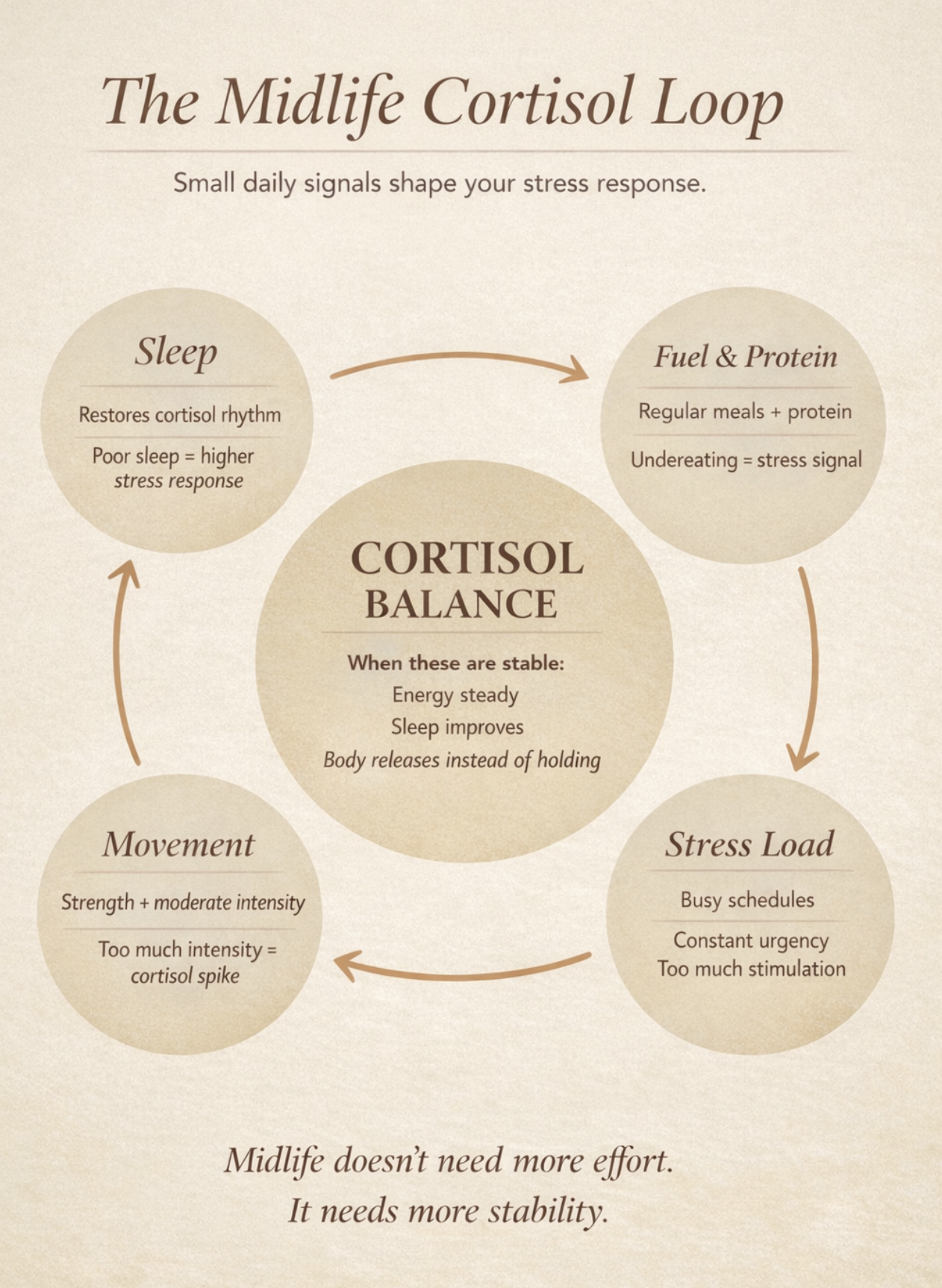
Poor sleep, long gaps without eating, excessive caffeine, high-intensity exercise without recovery, and ongoing mental pressure can keep cortisol elevated.
When cortisol stays high, the body remains on alert — leading to lighter sleep, energy crashes, and increased fat storage.
In midlife, this shift often becomes more noticeable.
Why Cortisol Feels Different After 40
During perimenopause and menopause, declining estrogen affects how the body regulates stress.
Estrogen helps buffer the stress response. As it drops, the nervous system becomes more reactive — and slower to recover.
The same triggers that once felt manageable may now feel amplified:
✻ Poor sleep
✻ Skipped meals or undereating
✻ Overtraining or excessive cardio
✻ Too much caffeine
✻ Constant urgency or mental load
Many women begin searching for answers to symptoms like:
✻ Waking at 3 a.m. during menopause
✻ Feeling anxious “for no reason”
✻ Energy spikes followed by crashes
✻ Feeling overstimulated or emotionally sensitive
This isn’t a personality change.
It’s a stress-response shift driven by hormonal change.
Signs Your Cortisol May Be Running High
→ Waking between 2–4 a.m.
→ Light, restless sleep
→ Afternoon energy crashes
→ Feeling alert at night but tired during the day
→ Increased belly fat
→ Sugar or caffeine cravings
→ Feeling overstimulated or unusually anxious
These patterns often reflect a disrupted cortisol rhythm rather than a lack of willpower or discipline.
The Wired-Tired Cycle
When cortisol stays elevated, the body shifts into protection mode.
From a biological perspective, this response makes sense. If stress signals remain high, the body conserves energy, holds onto resources, and prioritizes survival.
Research links chronically elevated cortisol to:
✻ Abdominal fat storage
✻ Blood sugar instability
✻ Sleep disruption
✻ Muscle breakdown and slower metabolism
This is why energy can feel inconsistent — alert at night, depleted during the day.
Why Pushing Harder Backfires After 40
When cortisol remains elevated, the body prioritizes protection over change. It becomes more likely to:
✻ Store fat around the midsection
✻ Break down muscle for energy
✻ Slow metabolism
✻ Increase hunger later in the day
This is why the traditional “eat less, exercise more” approach often stops working in midlife.
Your body isn’t being stubborn.
It’s responding to the signals it’s receiving.
Stability Over Intensity
The goal isn’t to eliminate stress.
The goal is to give your nervous system enough consistent signals of safety so cortisol can return to its natural rhythm.
For many women, this shift means:
✻ Prioritizing consistency over extremes
✻ Supporting recovery as much as effort
✻ Choosing steadiness over intensity
These aren’t soft habits.
They’re metabolic strategy for midlife.
Daily Habits That Quiet Cortisol in Midlife
Common Midlife Stress Signals
→ Skipping meals or eating too little
→Long gaps without protein
→Excess caffeine
→High-intensity workouts on poor sleep
→Back-to-back busy days without recovery
Supportive Signals for Your Nervous System
→Consistent meals with adequate protein
→ Strength training with recovery days
→Morning light exposure
→Moderate caffeine
→ Protecting sleep whenever possible
Small daily signals tell your body whether to stay on alert — or settle into stability.
The Bigger Picture
Understanding cortisol helps explain what many women feel but can’t quite name - why small stressors feel bigger, why sleep becomes fragile, why the push-harder approach stops working.
If you’re feeling wired but tired, waking at night, or noticing a new sensitivity to stress, cortisol may be part of the picture.
This isn’t weakness.
It’s biology adapting to a new hormonal environment.
Midlife often calls us to be more strategic — giving our bodies the signals it needs to work with us instead of against us.
As I wrote in Why Doing Less Started Doing More, this is often the turning point — when stability begins to create better energy, better sleep, and a calmer system.
Because in this season, calm isn’t giving up.
Calm is strength.
Medical Disclaimer
This article is for educational purposes only and is not intended as medical advice. Please consult your healthcare provider for personalized guidance.
